
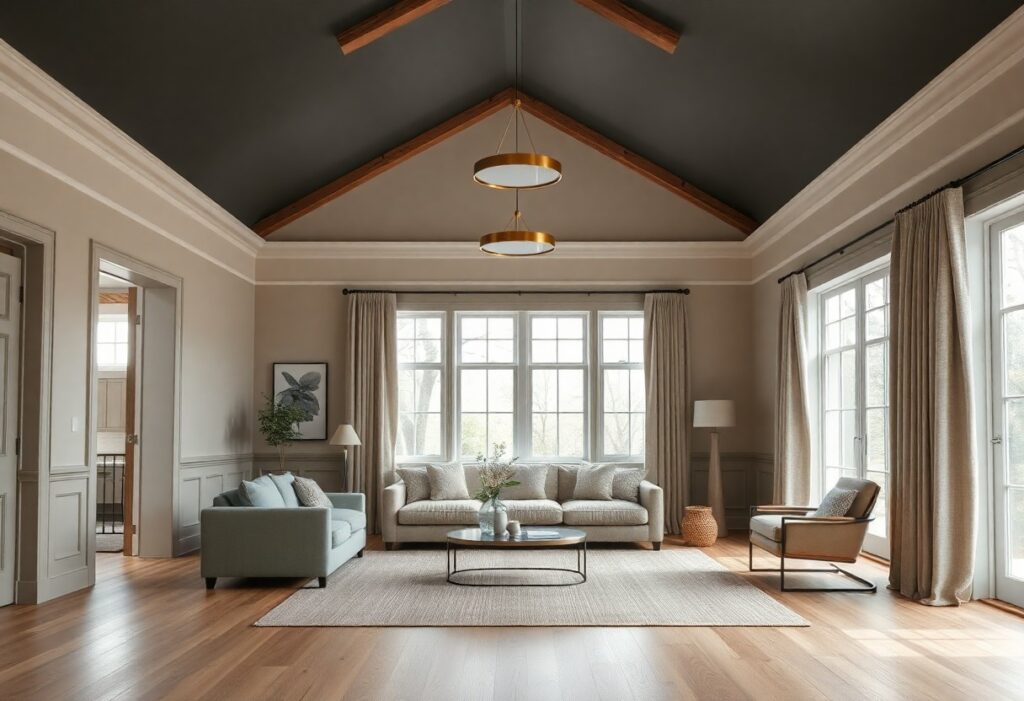
Over my years of refining interior spaces, I’ve seen how high ceilings can overwhelm a room, making it feel more like a cathedral than a home. You might love the openness, but without the right color strategy, that height can create emotional distance instead of grandeur. I’ll show you how specific hues can bring balance, warmth, and human scale back into your space.
Key Takeaways:
- Deep, saturated colors like navy, charcoal, or forest green applied to the ceiling can reduce the perceived height of a room, making large spaces feel more grounded and intimate without altering the architecture.
- Warm neutrals such as terracotta, ochre, or warm gray on upper walls and ceilings help create a sense of enclosure, drawing the eye inward and softening the vertical expanse in rooms with tall ceilings.
- Introducing a painted beam, decorative ceiling medallion, or subtle geometric pattern in a contrasting hue adds visual weight and breaks up vast overhead surfaces, as seen in many historic loft conversions in older urban buildings.
The Gravity of Melancholy Hues
I’ve seen deep navy or charcoal gray applied to high ceilings with the intention of adding sophistication, only to leave a space feeling emotionally heavy. While these colors carry a certain elegance, their density can amplify a room’s verticality in a way that feels isolating rather than dramatic. You risk creating an atmosphere that leans toward the somber, especially in rooms with limited natural light. I caution against using cold, saturated darks without balancing them with warm layers below-otherwise, the ceiling appears to recede upward while emotionally weighing down the space.
The Intimacy of Earthly Pigments
I find that warm, natural tones like terracotta, ochre, and deep sage ground a space in a way cooler hues rarely do. These earthly pigments absorb light gently, reducing the cavernous effect high ceilings can create. You don’t need to saturate every wall-just one accent wall in a rich clay tone can make the room feel more contained. I’ve seen a mid-sized SaaS firm repaint a 12-foot lobby with a muted burnt sienna, and the change made visitors linger longer, drawn in by the warmth. Earthy colors signal shelter, not expanse, which is exactly what tall rooms often lack.
The Art of the Visual Horizon
I anchor expansive ceilings by establishing a visual horizon line partway up the wall, typically at eye level or slightly above. Painting a band of warm, mid-tone color-like terracotta, olive, or ochre-in this zone draws the eye outward rather than upward, softening the sense of vertical excess. I’ve used this technique in a cathedral-ceilinged living room where a 6-inch wraparound glaze in burnt sienna effectively lowered the perceived ceiling height without architectural changes. The brain registers the color band as a boundary, creating psychological comfort through implied enclosure. Even in open-plan spaces, this method maintains spatial flow while adding grounded balance.
The Boredom of the Blank Slate
I’ve watched clients hesitate after painting an expansive ceiling stark white, expecting brightness but instead feeling a hollow, almost institutional chill. That blank slate, while seemingly neutral, amplifies the scale of a room too dramatically, making it feel less like a sanctuary and more like an unfinished shell. You might assume white recedes, but in large doses overhead, it can create a sense of emotional sterility that no amount of décor easily fixes. I once advised against pure white for a cathedral ceiling in a mid-sized SaaS firm’s lounge-opting instead for a warm greige-and the shift in perceived comfort was immediate and palpable.
Summing up
I find that warm, mid-tone hues like terracotta, olive green, or soft ochre help bring a high ceiling into better visual proportion. You don’t need to cover every wall in dark paint-using these colors on the upper third or in a bold ceiling treatment can pull the space down with quiet confidence. In your home, a carefully chosen shade can transform an echoing atrium into a grounded, livable volume, much like the way a well-placed beam defines a cathedral’s height without losing its warmth.